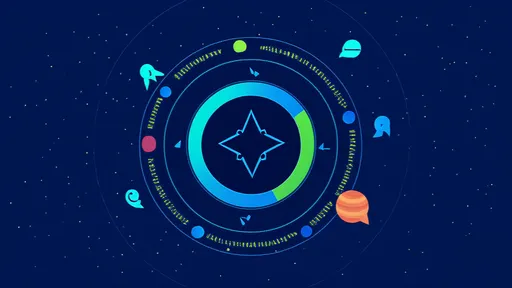
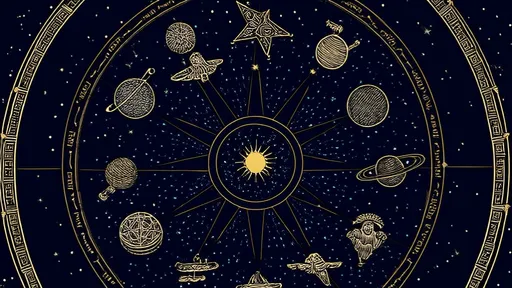
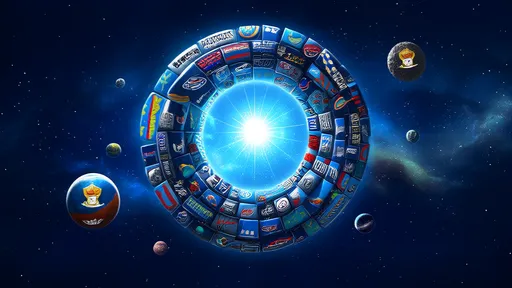
In the ever-evolving cosmos of modern marketing, the concept of brand loyalty has transformed from a simple transactional relationship into a complex gravitational force that holds entire consumer ecosystems together. The planetary model of marketing strategy offers a compelling framework for understanding how brands can cultivate and maintain this loyalty in an age of unprecedented choice and connectivity. This approach visualizes the brand as a central sun around which various consumer planets orbit, each with its own unique characteristics, needs, and orbital patterns that require tailored gravitational pulls.
The fundamental principle of planetary marketing lies in recognizing that not all customers demonstrate the same level of allegiance or engagement. Some consumers exist in close orbit, demonstrating what astronomers would call tidal locking—they consistently face the brand with unwavering loyalty and serve as gravitational anchors for the entire system. These core loyalists form the brand's foundation, providing stable revenue streams and authentic advocacy that no amount of advertising can purchase. Their gravitational pull actually influences other consumers, creating a natural attraction that extends the brand's reach far beyond what traditional marketing could achieve alone.
Moving outward from this core, we encounter what might be termed the habitable zone of occasional loyalists—those consumers who maintain multiple brand relationships but consistently return to your orbit when specific needs arise. These planets maintain stable but distant orbits, requiring careful navigation and consistent value delivery to prevent them from drifting into competing gravitational fields. Their loyalty is conditional rather than absolute, influenced by factors ranging from seasonal preferences to competitive promotions. The challenge for marketers becomes maintaining just enough gravitational pull to keep these valuable bodies within the system while recognizing that their natural state involves orbiting multiple stars.
Beyond these engaged orbits exist what astrophysicists might call rogue planets—consumers with no fixed brand allegiance who drift through the marketing universe largely unaffected by gravitational pulls. These nomadic consumers represent both a challenge and opportunity, as their conversion into even occasional loyalists can significantly expand a brand's cosmic footprint. Their movement patterns often appear random to traditional marketers, but advanced analytics now allow us to detect subtle patterns and gravitational influences that might capture these free-floating entities.
The gravitational forces that maintain these orbital relationships are not mysterious cosmic phenomena but carefully crafted marketing elements. Product quality forms the fundamental mass around which everything else orbits—without sufficient substance, no amount of marketing gravity can maintain stable consumer orbits. Customer experience creates the atmospheric conditions that make planets want to remain in orbit, while consistent communication generates the electromagnetic pulses that keep the system connected. Value proposition determines the strength of the gravitational pull, and emotional connection creates the mysterious dark matter that binds everything together in ways we can measure even when we cannot directly observe.
Modern technology has transformed our ability to map and understand these cosmic relationships. Advanced analytics function as sophisticated telescopes, allowing marketers to track planetary movements with unprecedented precision. Artificial intelligence serves as the orbital mechanics calculator, predicting trajectory changes and identifying potential system disruptions before they occur. Social listening tools act as cosmic background radiation detectors, picking up the faint signals of shifting consumer sentiments across the vast marketing universe. These technological advancements have transformed brand management from art to science while preserving the creative spark that initially set the universe in motion.
The most successful planetary systems—those brands that maintain stable, expanding universes of loyal consumers—understand that gravity works both ways. While the brand exerts gravitational pull, loyal consumers themselves develop mass that attracts other consumers. This creates a self-reinforcing system where loyalty begets more loyalty, and gravitational strength grows organically over time. This phenomenon explains why established brands with strong loyalist cores can sometimes seem to defy market physics, maintaining their position despite competitive challenges that would destabilize less developed systems.
Orbital decay represents the constant threat in any planetary marketing system. Even the most loyal consumers will eventually drift away if the central star fails to maintain its energy output or if competing gravitational forces become too strong. This decay often happens gradually, with orbits slowly widening until the connection finally breaks. Vigilant marketers monitor for signs of orbital decay through declining engagement metrics, reduced purchase frequency, and weakening advocacy indicators. Early detection allows for gravitational corrections through re-engagement campaigns, refreshed value propositions, or enhanced experiences that pull drifting planets back into stable orbits.
Solar flares of brand controversy or crisis can dramatically affect entire systems, sometimes pushing otherwise stable planets into new trajectories. How a brand weathers these stellar events often determines its long-term cosmic survival. Transparent communication acts as radiation shielding, protecting consumer planets from the worst effects. Consistent action provides gravitational stability during turbulent times. Authentic contrition when necessary functions as a course correction that maintains orbital integrity. The brands that survive these eruptions often emerge with stronger gravitational bonds, having demonstrated their substance under extreme conditions.
The expansion of the marketing universe continues accelerating, with new stars igniting constantly and existing systems merging through acquisitions and partnerships. This cosmic expansion creates both challenges and opportunities for brand astronomers. The increasing distance between planets requires stronger communication systems to maintain connection. The growing number of celestial bodies demands more sophisticated tracking and engagement technologies. Yet this expansion also creates opportunities for gravitational capture of new planets and the development of entirely new orbital systems around brand extensions and innovations.
Ultimately, the planetary marketing model teaches us that loyalty cannot be commanded—only earned through consistent gravitational excellence. Brands that understand their place as central stars in complex consumer systems, that recognize the different orbital patterns of their planetary followers, and that maintain the energy output required to keep their systems intact will thrive in the expanding marketing universe. Those that fail to generate sufficient gravitational pull will find their planets drifting away to orbit brighter stars with stronger fundamental substance. The cosmic truth of modern marketing remains unchanged: mass attracts mass, value creates gravity, and loyalty orbits consistently around excellence.

By /Aug 25, 2025

By /Aug 25, 2025

By /Aug 25, 2025

By /Aug 25, 2025
By /Aug 25, 2025

By /Aug 25, 2025

By /Aug 25, 2025

By /Aug 25, 2025

By /Aug 25, 2025

By /Aug 25, 2025

By /Aug 25, 2025

By /Aug 25, 2025
By /Aug 25, 2025
By /Aug 25, 2025

By /Aug 25, 2025

By /Aug 25, 2025
By /Aug 25, 2025

By /Aug 25, 2025
By /Aug 25, 2025
By /Aug 25, 2025